


Operating principle of the heat exchanger
You are here:
- Home
- Interessantes
- Operating principle of the hea…
Heat exchanger operating principle explained simply
Heat exchangers are among the quiet but indispensable heroes of industry. They make it possible to transfer thermal energy between two media without them mixing directly. It sounds simple—but it is the basis for a wide range of industrial processes: from temperature control of chemical baths and air flows, condensing and extracting substances, through to efficient heat recovery.
Heat exchangers – operating principle and main purpose
A hot medium releases heat; a cold medium absorbs it. The two media are always separated from each other so that no mixing occurs. This enables energy to be transferred efficiently—during heating, cooling, condensing, or evaporation.
Fundamentals of thermodynamics
The function of a heat exchanger is based on the laws of thermodynamics:
Three factors play a decisive role in the efficiency of a heat exchanger:
In addition, flow velocities and the resulting flow regimes also play a key role. They determine how effectively heat can be transferred at the surface of the heat exchanger. In practice, this means: A heat exchanger with optimized flow routing can operate significantly more efficiently with the same overall size.
Differences depending on the medium
have a lower density and thermal conductivity than liquids. Therefore, gas-liquid heat exchangers must provide larger exchange surfaces and the flow routing must be optimized to ensure efficient heat transfer.
Here, in addition to thermal conductivity, chemical resistance comes into play. Corrosive media require heat exchangers made of materials that are not attacked—for example, PE, PP, or PVDF. In addition, the density and viscosity of such media are often higher, which influences the flow and must be taken into account in the design.
Practical example
In exhaust air treatment in chemical plants, heavily contaminated Exhaust Air often has to be extracted. This Exhaust Air has high energy potential in the form of waste heat. This is where plastic gas-liquid heat exchangers are used to recover heat and energy from aggressive Exhaust Air.
With liquids, the difference can be seen, for example, in cooling circuits in metal processing, where water is used as the cooling medium. Acids and lye, on the other hand, are found in Plating and Metal Processing or electroplating. There, the choice of Material for the heat exchanger is crucial for a long service life.
You are currently viewing a placeholder content from YouTube. To access the actual content, click the button below. Please note that doing so will share data with third-party providers.
More InformationThese media can be used in the heat exchanger
A major advantage of heat exchangers is their high flexibility. The process works almost regardless of which media are used—only temperature, pressure, and material resistance are decisive.
This makes heat exchangers universally applicable—from agriculture to semiconductor production.
Typical examples:
Air-to-air heat exchangers
Air-to-air heat exchangers
for heat recovery in passive houses.
Vapour-liquid heat exchanger
Vapour-liquid heat exchanger
for high temperatures in the chemical industry, for example when heating solvents or process baths, and when condensing process steam.
Heat exchangers: universal solutions for industry and innovation
In addition to these classic combinations, there are numerous special applications. For example, heat exchangers are used in the food industry to cool milk or beverages, in aquaculture to control the temperature of tank water, or in energy technology to cool battery systems. In addition, innovative fields of application are emerging, such as heat recovery in drying processes, producing drinking water from air through condensation, processing electronic waste, and recovering rare earths. The versatility of the technology makes heat exchangers universal tools for virtually all industrial sectors.
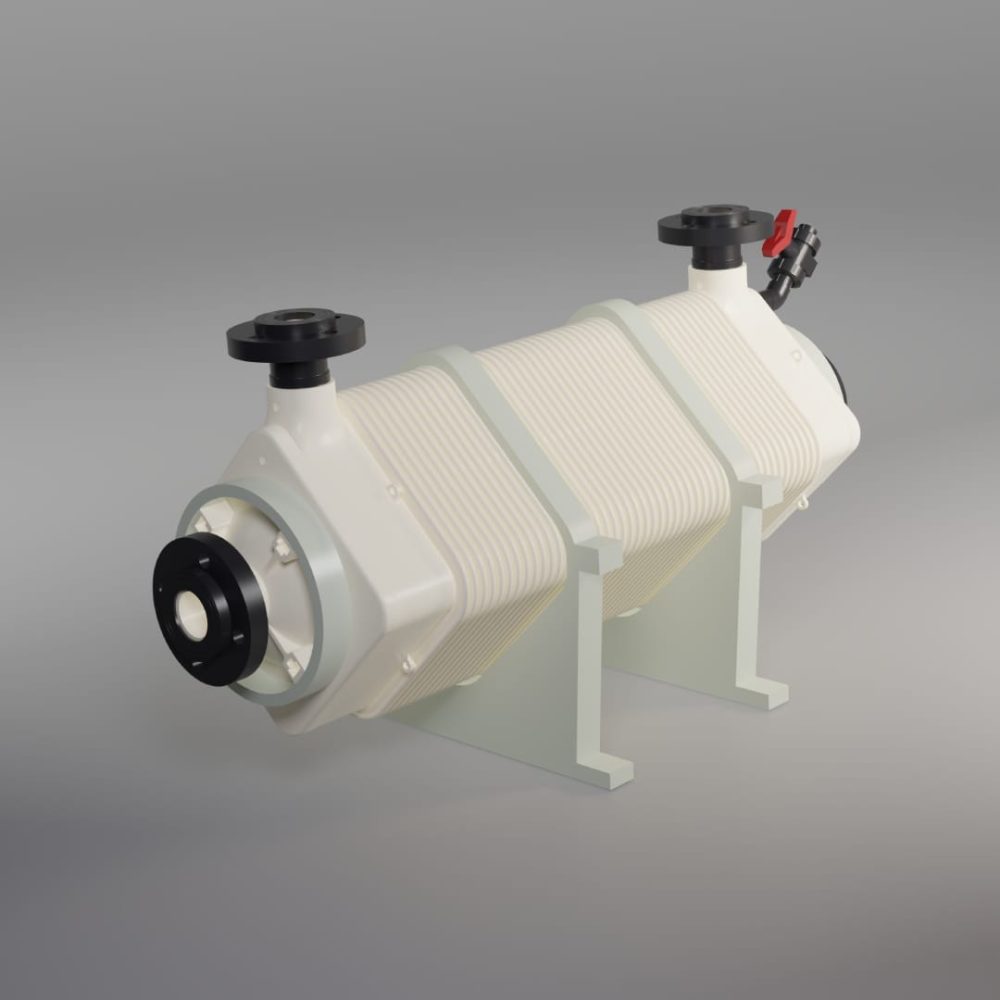
Classification by heat transfer
Although the basic principle always remains the same, heat exchangers are classified according to how heat is transferred:
Both media are in direct contact with a shared surface (e.g., shell-and-tube and plate heat exchangers).
In practice, this means: For applications with high safety requirements, such as in the pharmaceutical industry, indirect systems are often used, while regenerative heat exchangers dominate in building services engineering. The appropriate design is selected depending on the process conditions.
Classification by flow arrangement
In addition to the transfer type, it is crucial how the media are routed past each other:
Parallel flow
Both media flow in the same direction; temperature differences equalize evenly.
Counterflow
The media flow in opposite directions, enabling particularly high heat exchange (most common design).
Crossflow
The media cross at right angles, often in ventilation and air-conditioning systems.
Hybrid configurations
Combination of different flow types to increase efficiency.
A clear example: In wastewater treatment plants, the counterflow principle is often used because it enables efficient energy recovery even with small temperature differences. In building air conditioning, on the other hand, crossflow is common because it allows a compact design while maintaining high performance.
These are the benefits of using heat exchangers
Using a suitable heat exchanger offers numerous advantages:
Industry-specific benefits:
Contribution to achieving climate targets through efficient heat recovery.
Conclusion: Heat exchangers are key to efficiency and safety
Wärmetauscher sind zentrale Bausteine effizienter und sicherer Industrieprozesse. Ob bei der Energieeinsparung, der Temperierung verschiedener Medien oder der nachhaltigen Abwärmenutzung – die richtige Auswahl und Auslegung ist entscheidend.
At Calorplast Wärmetechnik GmbH, you have been receiving customized plastic heat exchangers for over 40 years—reliably operating even under extreme conditions. From simulation to production, we provide expertise, safety, and efficiency—Made in Germany.
The future of heat exchanger technology lies in the combination of customized design, sustainable materials, and digital simulation.
Looking for industrial heat recovery solutions? We would be happy to help you find the right solution for your application.
Interesting facts and information from the world of CALORPLAST


