


Water from air in desert regions
You are here:
- Home
- Interessantes
- Water from air in desert regio…
Sustainable water production with corrosion-resistant heat exchangers
The availability of clean drinking water is one of the greatest global challenges of our time. Climate change, population growth, and increasing water demand in industry and agriculture are leading to ever more severe shortages. Especially in arid regions with little rainfall, innovative technologies are needed that can operate independently of conventional water sources.
One promising solution is atmospheric water harvesting – a process that uses naturally occurring humidity to produce drinking water from air. The choice of materials, particularly for heat exchangers, plays a crucial role in ensuring efficiency and sustainability. Calorplast provides durable plastic heat exchangers that operate reliably even under extreme conditions.
Key facts about water from air in desert regions
- Clean drinking water from air – independent of groundwater or surface water
- Works even in extremely dry regions such as the Negev Desert
- Uses energy-efficient liquid absorption systems, such as brine-based processes
- PE-RT heat exchangers ensure corrosion resistance and a long service life
- A sustainable, decentralized solution for industry and water-scarce regions
The global water crisis as a challenge
Clean drinking water is becoming increasingly scarce worldwide. Climate change is altering precipitation patterns, while population growth and rising water consumption in agriculture and industry are putting increasing pressure on natural resources.
At the same time, bottled water consumption is increasing – with significant environmental and financial impacts caused by packaging, transportation, and disposal.
This creates a growing need for technologies that enable a reliable, sustainable, and independent water supply.
How to produce water from air – how atmospheric water harvesting works
By cooling air or chemically binding the moisture it contains, water can be extracted from air even in dry regions – without relying on groundwater or rainfall.
Air always contains a certain amount of water vapor, even in desert regions. This moisture can be converted into liquid water using various physical or chemical processes. One fundamental principle is condensation: when air is cooled, it reaches its dew point, at which the water vapor it contains begins to condense.
Alternatively, water can be captured through absorption or adsorption and subsequently released again. Water harvesting from air therefore provides a sustainable alternative to conventional drinking water sources.
Processes and technologies for atmospheric water harvesting
There are several technical approaches for extracting water from atmospheric humidity. The main methods used for atmospheric water generation are:
Each method has specific advantages and disadvantages, particularly in terms of energy efficiency and operating conditions.
Direct cooling – why it reaches its limits in dry air
With direct cooling, air is actively cooled until the water vapor it contains condenses. This process works very well in regions with high humidity. In dry desert air, however, this type of water extraction from air is highly energy-intensive and inefficient.
This results in high energy consumption, low water yield, and often ice formation on the heat exchangers.
This form of atmospheric condensation is technically demanding and rarely economical in dry air. In practice, direct cooling is therefore mainly suitable for humid climate zones or as a supplementary process.
Membrane-based processes
More recent concepts use semipermeable membranes that allow water molecules to pass through while retaining other gases. These technologies are still under development but are considered promising for compact, low-maintenance atmospheric water generator systems.
Adsorption and absorption – efficient at low humidity
Processes based on chemical moisture capture are significantly more efficient. They use hygroscopic materials such as brine solutions, zeolites, or silica gels, which can absorb water even at very low humidity levels. The captured water is then released again through heating or under reduced pressure. These processes can operate at relative humidity levels below 10% – conditions in which direct cooling reaches its limits.
Example: Brine-based water production from desert air
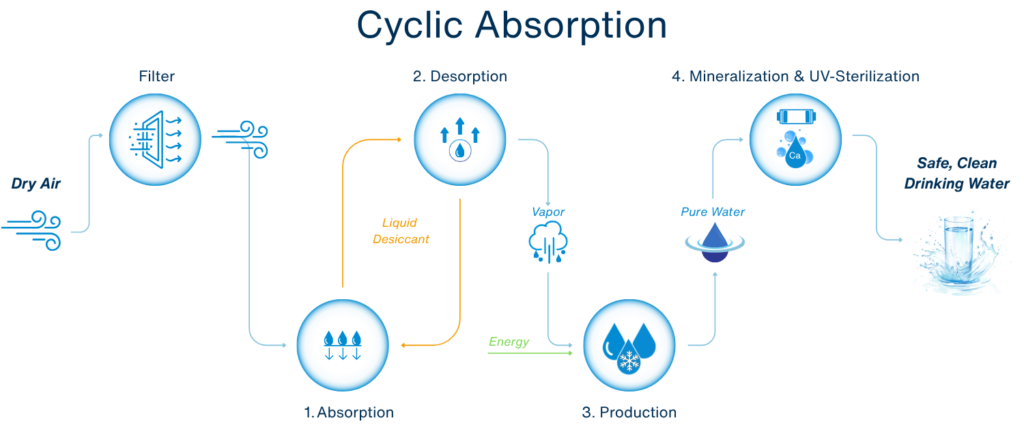
H2OLL’s brine-based process, an innovative atmospheric water generator, uses a continuous liquid absorption process in which a brine solution captures moisture directly from the air. During the absorption cycle, moisture is absorbed from the ambient air. In the subsequent regeneration cycle, the water is released again through low-pressure distillation.
In this process, energy is used exclusively to condense the evaporated water – a key advantage over energy-intensive direct cooling. The result is a particularly energy-efficient, reliable, and sustainable water production from air process that operates even in extremely dry regions such as the Negev Desert.
Drinking water from desert air – applications in extremely dry regions
Systems for water generation from air provide a decentralized solution to water scarcity – independent of existing infrastructure or conventional water sources. Systems based on liquid absorption processes can provide clean drinking water year-round and can be further optimized by using solar energy or waste heat. This enables scalable solutions for regions with unreliable water supplies, industrial companies seeking to meet their drinking water needs independently, and organizations looking to reduce the environmental and financial impact of bottled water.
Plastic heat exchangers for sustainable water generation systems from Calorplast
PE-RT heat exchangers ensure efficiency, durability, and corrosion resistance – key requirements for reliable atmospheric water generation systems.
A central component of these systems is the heat exchanger, which controls the temperature of the brine solution throughout the process.
During the regeneration step, the brine previously enriched with water is heated under reduced pressure.
The heat exchanger transfers heat from the ambient air or an external energy source to the brine.
The reduced pressure lowers the boiling point of the water, allowing the water bound in the brine to evaporate at relatively low temperatures.
The resulting water vapor is then condensed, producing clean, distilled water.
This principle enables energy-efficient and continuous water production from air, even at very low humidity levels.
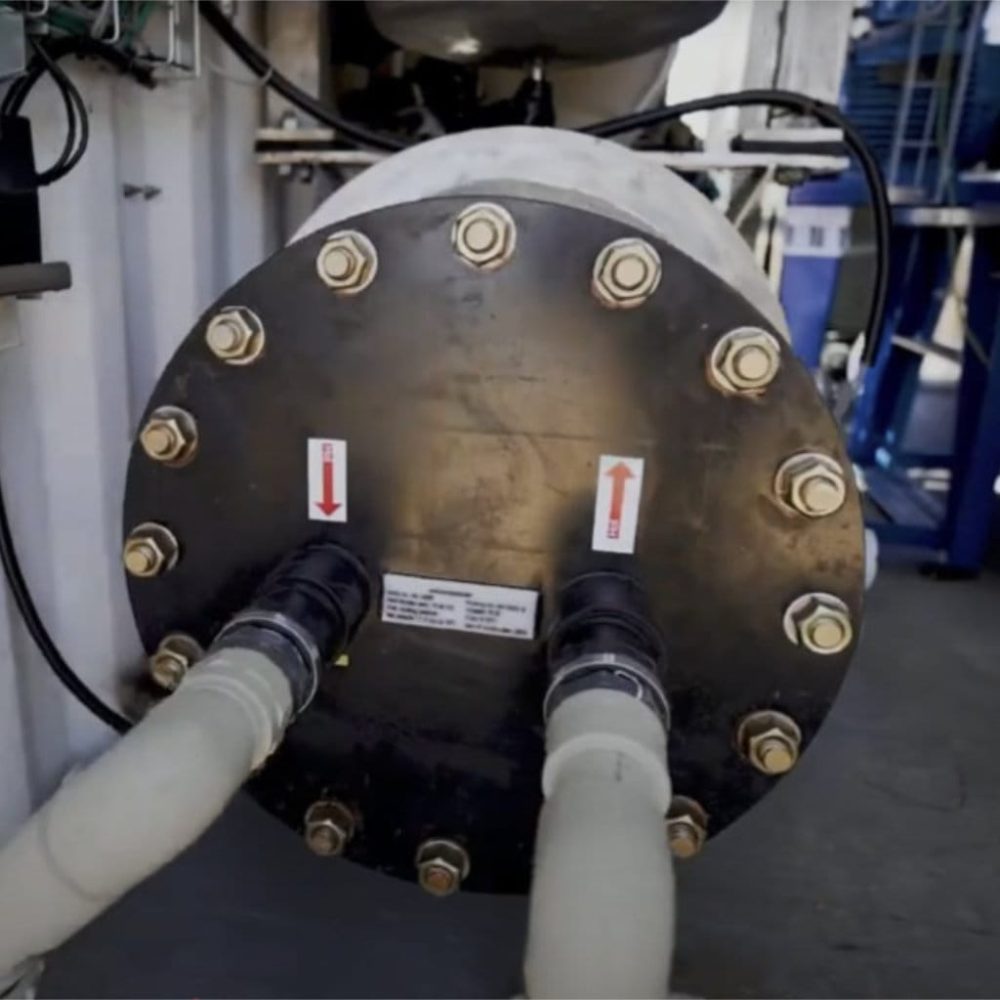
Many early systems used titanium heat exchangers.
In practice, however, these showed clear limitations:
– Contact with saline brine solutions led to corrosion despite the use of metal
– Limited service life and high maintenance requirements
– Rising operating costs due to material degradation
The solution: Calorplast plastic immersion heat exchangers.
Made from PE-RT (polyethylene of raised temperature resistance), they are specifically designed for applications in which metals fail over the long term.
These heat exchangers are an integral component of modern atmospheric water harvesting systems, where corrosion resistance and efficiency are critical.
Why metal fails and plastic performs
Corrosive media such as concentrated brine attack metals at a microscopic level – even titanium can corrode at high temperatures or when exposed to chloride ions. Plastic, by contrast, is chemically inert and electrically non-conductive, making it ideal for continuous operation in such environments. As a result, Calorplast plastic heat exchangers not only provide a significantly longer service life but also maintain consistently high efficiency over many years.
The advantages of Calorplast plastic heat exchangers
Maximum corrosion resistance
No corrosion, no material failure – even after years of use in aggressive media.
Significantly longer service life
PE-RT significantly outperforms titanium and stainless steel heat exchangers under extreme conditions.
High cost-effectiveness and maximum system availability
Thanks to longer maintenance intervals, extended service life, and reduced replacement costs.
Sustainable material selection
Plastic reduces environmental impact and supports sustainable concepts.
Your project – our solution: Request a personal consultation
Calorplast – your partner for corrosion-resistant heat exchangers in demanding applications.
Contact us to find out how our technology can make your systems more efficient, durable, and sustainable.

Potential of atmospheric water harvesting for water-scarce regions and industrial projects
The ability to generate water independently of rivers, lakes, or groundwater opens up new opportunities for regions around the world – wherever access to clean drinking water is limited or unreliable. Atmospheric water harvesting systems can be used in a wide range of environments: in arid regions, on islands, in crisis-affected areas, as well as in industrial and urban areas facing increasing water scarcity.
These modular systems can be operated locally, scaled to meet specific requirements, and combined with renewable energy sources. In this way, they can make an important contribution to a stable, secure, and environmentally friendly water supply – independently of existing infrastructure.
Water generation from air can therefore contribute not only to water supply in desert regions, but also to supply security and climate protection in water-scarce industrial areas.
Innovation meets real-world application: Calorplast as a technology partner for atmospheric water harvesting
For decades, Calorplast has been developing and manufacturing corrosion-resistant plastic heat exchangers for demanding industrial applications – from chemical processes to sustainable water technologies.
With extensive engineering expertise, in-depth materials know-how, and customized solutions, Calorplast supports the development and implementation of efficient systems for producing drinking water from air.
Plastic heat exchanger solutions for plant manufacturers, engineers, and research
Whether in water treatment, ventilation systems, or thermal processes – wherever corrosion poses a risk, Calorplast plastic heat exchangers are a reliable choice.
Engineers and system designers benefit from individual consultation, simulation, and customized manufacturing – ensuring optimal integration into complex system designs.
Looking for heat transfer solutions for your company?
Get in touch with us – we’ll be happy to help.
Interesting facts and information from the world of CALORPLAST


